Remote visual support for equipment manufacturers
Remote support that needs nothing installed at the customer's site.
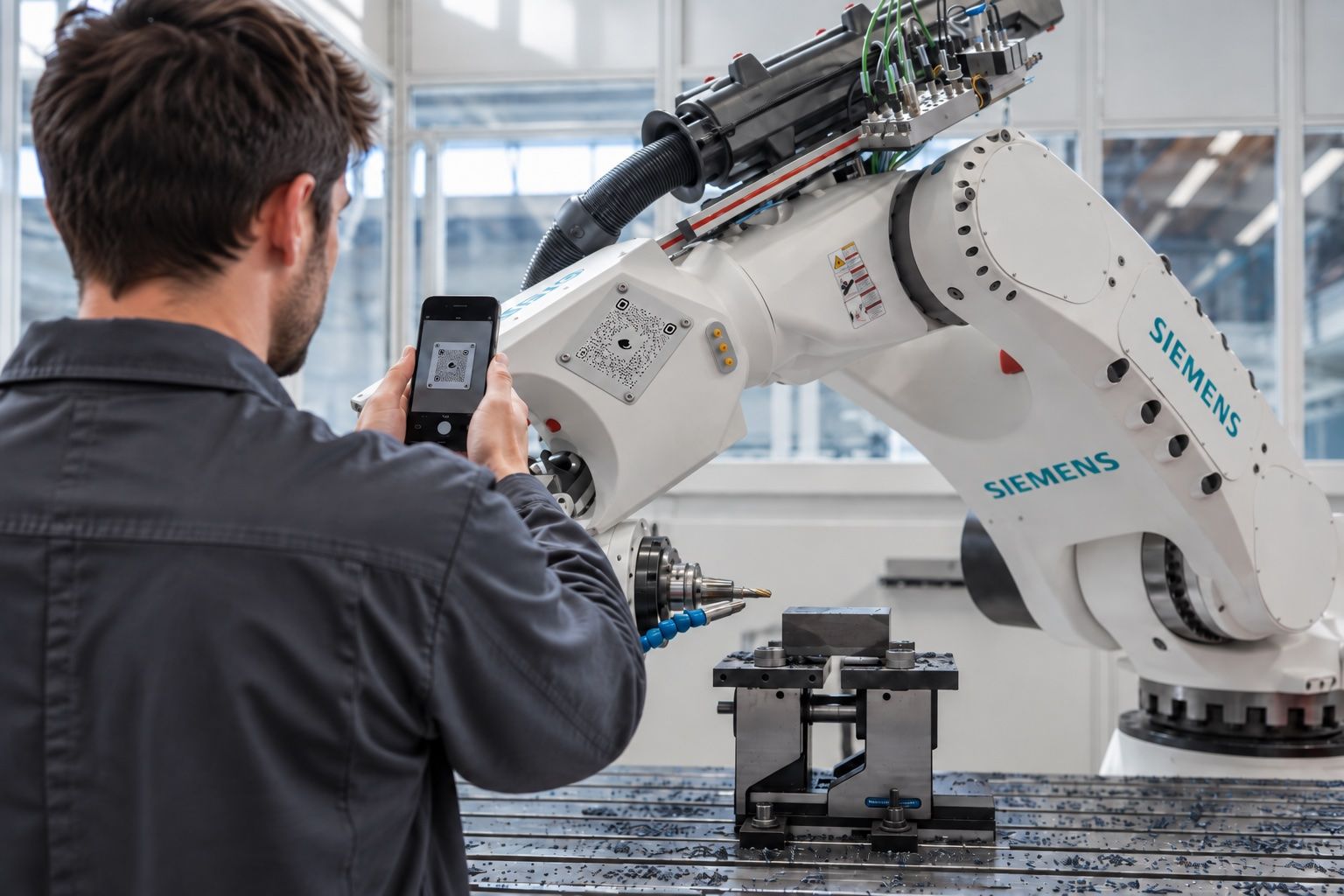
A QR code on the equipment connects the person standing in front of the fault to the right support engineer. It opens in their browser. No app, no account, nothing for their IT to approve.
How many of last quarter's call-outs needed someone on site?
Not how many were booked. How many, once your engineer arrived, turned out to be something the customer could have handled with a competent person watching.
Service teams tend to have a rough number for this, and tend not to like it.
01 / The route
One code on the machine. One tap. The right engineer.
The QR code is fixed to the equipment. When something goes wrong, whoever is standing in front of it scans it. The call opens in their browser.
The link carries the context. Branch, department, account, and the asset itself are already inside the code, so the call arrives at the right engineer with the customer and machine identified. Nobody reads out an account number.
Your engineer sees the fault instead of hearing it described. They talk the person through it, or they establish quickly that this one genuinely needs a visit, and know which part to bring.
Every code is a Face2 link carrying its own routing.
oktium.com/business/<your-account>/?branchId=…&departmentId=…&accountId=…&title=… The title identifies the specific machine or site, so the call log traces back to the asset.
02 / The alternatives
Why not the tools you already own.
- 01
A phone call.
Your engineer is working from a description written by someone who does not use your vocabulary. Everything after that is inference.
- 02
A consumer video app.
Now the customer needs the app, an account, and a meeting link, arranged while a line is down. In practice the call happens on a phone held by whoever already had it installed.
- 03
A remote-assist platform.
Capable, and generally built on the assumption that the customer side is provisioned first — software, accounts, sometimes headsets. That is a rollout before the first call.
- 04
Sending an engineer.
Definitive, and the most expensive way to discover the problem was a setting.
Siemens uses Oktium as a support channel.
Siemens places a Face2 QR code on the equipment. When their customer needs support, the person at the machine scans it and reaches a Siemens support mechanic live, routed to the right department.
03 / Your arithmetic
You already know what a site visit costs you.
Take your own number. Travel, the engineer's day, the parts that went along in case. Multiply it by the share of call-outs that turned out not to need anyone on site.
That figure is the size of the problem. We are not going to guess it for you, and you should be sceptical of anyone who does.
Who this fits
Worth your time if:
- you have an installed base in the field, across customer sites you do not control
- your support engineers work at desks and could take a call now
- a meaningful share of your call-outs are diagnostic rather than mechanical
- your customers' staff are on their own phones, not devices you issue
Probably not, if:
- your equipment sits in environments where phones are not permitted or have no signal
- your support model is contractual on-site cover, where a visit is the product
- the fault types you handle genuinely cannot be assessed by eye
We would rather you worked that out here than three months into a pilot.
04 / Start small
One product line. One quarter.
Not a platform decision. Pick one machine type or one site.
- 01Face2 QR codes generated and print-ready for that line
- 02routing set up to the engineers who already take those calls
- 03your team answering in the OKTIUM 4B iOS app on phones they already use
- 04call logs against each asset, so the pilot produces its own evidence
SCOPE THE PILOT
Choose one line. We will map the first route with you.
Tell us where a remote visual check could replace a first visit. We will show you what a Face2 route looks like for that equipment.
Talk to us