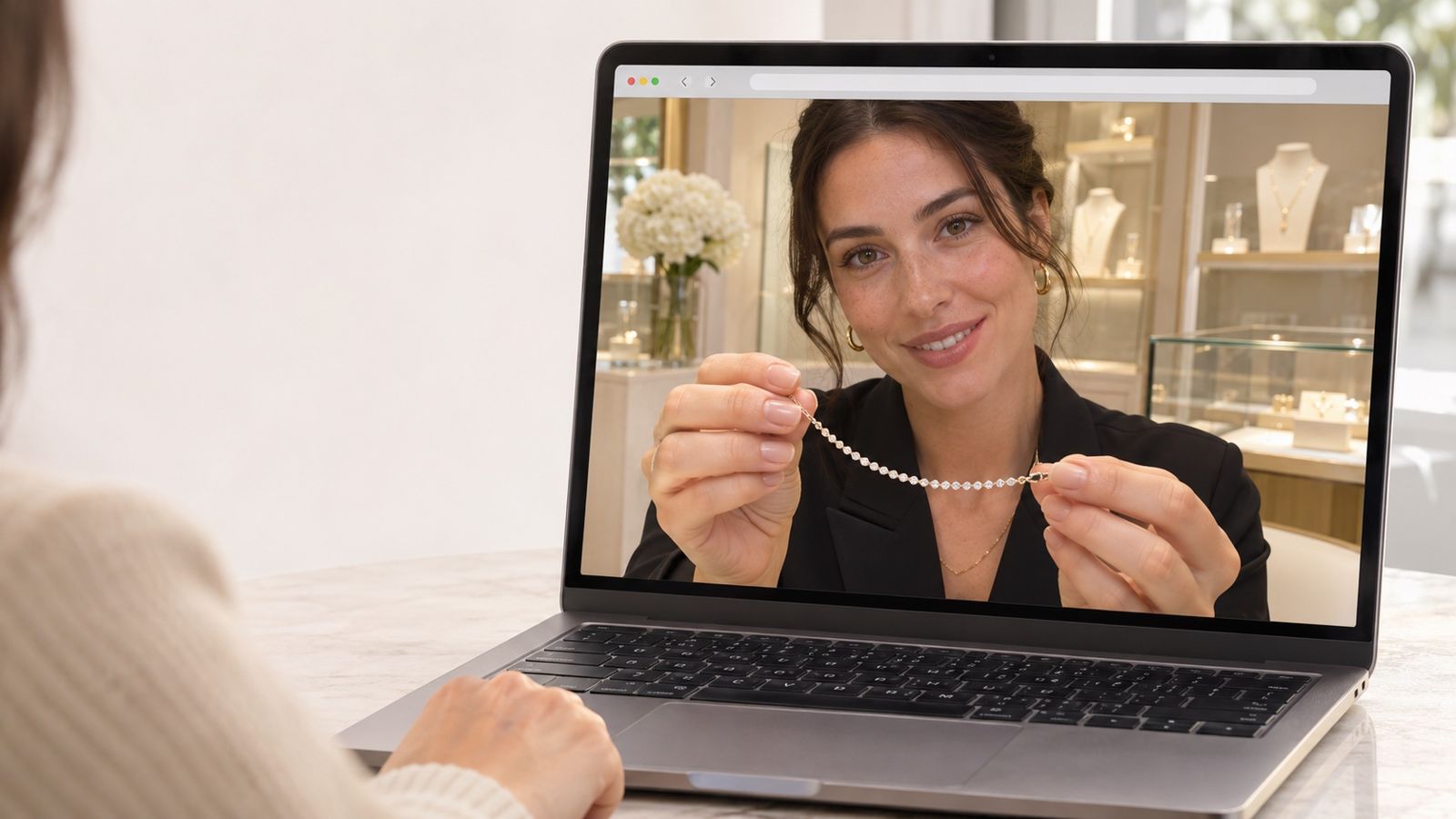
A livestream can introduce a product to thousands of people. A personal video conversation can help one customer decide whether it is right for them.
Both belong in an e-commerce strategy. They solve different problems.
For e-commerce directors, the choice starts with the obstacle between a shopper and a purchase. Does the customer need to discover your products? Or have they already found something they want, but need a question answered before buying?
That distinction is where live video commerce becomes useful.
What is the difference between live video commerce and livestream shopping?
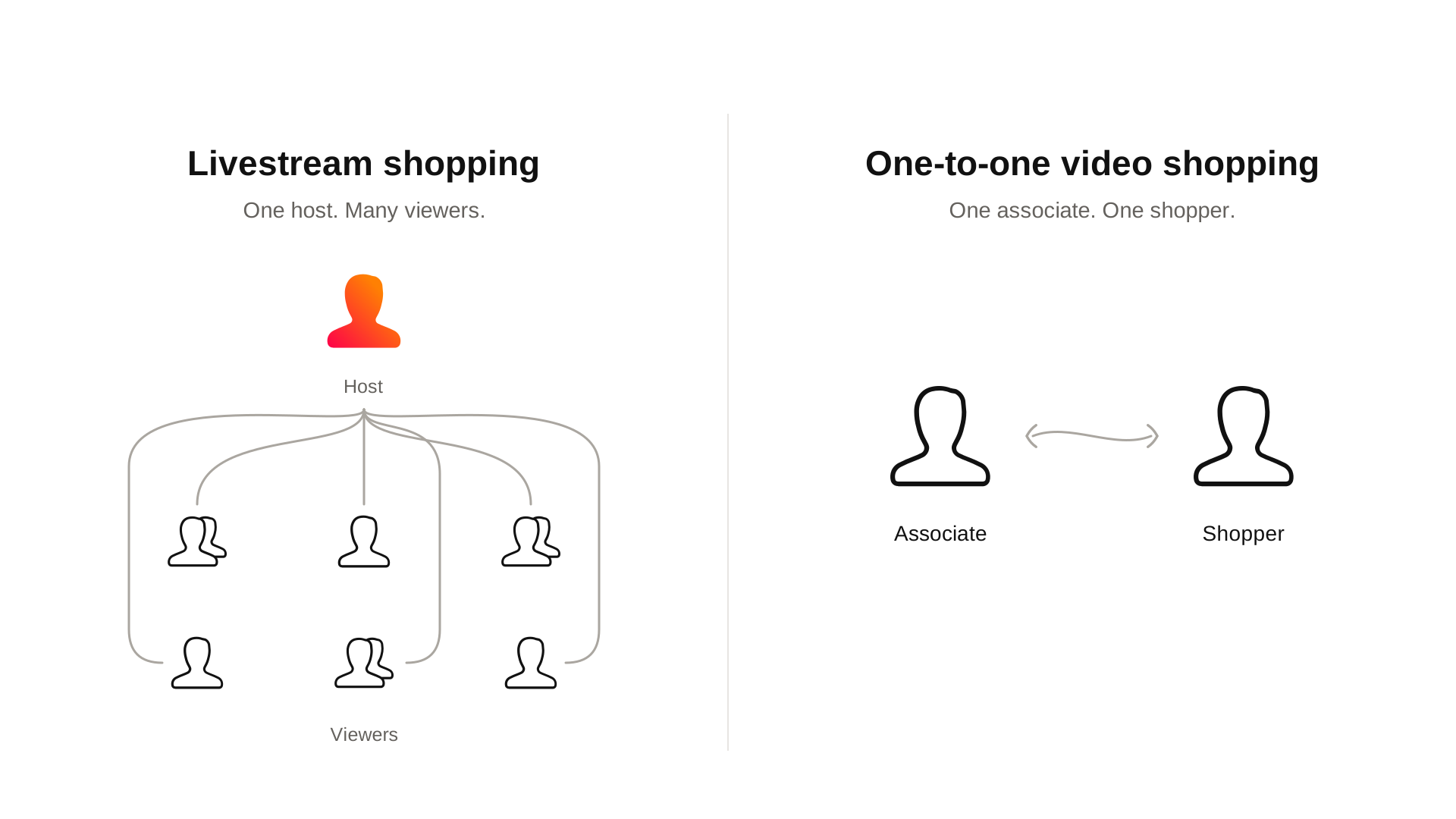
Live video commerce is a broad category covering shopping experiences supported by live video. It includes both broadcast events and personal consultations.
Livestream shopping usually means a host presenting products to an audience. Viewers watch demonstrations, ask questions through chat, and follow links or use shopping features to purchase.
One-to-one video shopping connects an individual customer with a salesperson for a real-time conversation. The customer can ask specific questions, see products demonstrated, compare options, and receive guidance relevant to their purchase.
The practical difference is how much the interaction can adapt to one shopper.
| Comparison | Livestream shopping | One-to-one video shopping |
|---|---|---|
| Interaction | One host or team serves an audience | One salesperson helps one customer |
| Useful for | Launches, discovery, demonstrations, community events | Personal advice, detailed comparisons, purchase decisions |
| Customer questions | Usually submitted through shared chat | Discussed directly with the salesperson |
| Operating requirement | Audience building, hosting, production, moderation | Available staff, product knowledge, routing |
| Measurement focus | Reach, viewer purchases, event contribution | Connection rate, assisted purchases, contribution per staff hour |
A broadcast can answer questions. A personal consultation can follow a customer's questions wherever they lead.
Can one-to-one video shopping convert at 40% or more?
Published examples show that it can—including Oktium's own retail deployment.
In our Trollbeads case study, the flagship store in Prague recorded a 47% conversion rate on answered calls over the first 15 months following its December 2020 deployment. Nearly one in two answered video consultations resulted in a purchase. The store answered 60% of incoming inquiries, making staff availability an important part of the picture.
Third-party examples support the potential. Appointment platform Booxi reports a 43% conversion rate for one client using its integration with Bambuser for virtual shopping appointments. Both figures describe individual client results, rather than industry-wide benchmarks. Read the Booxi example.
It would also be misleading to say livestream shopping generally converts at just 1–2%. McKinsey's 2023 research reported purchase conversion of 30–36% among frequent live-commerce users across the markets surveyed. Its measure was the percentage of shows a respondent attended and purchased during or after—not purchases divided by every broadcast viewer. Read McKinsey's research.
These figures need context. Answered calls, booked appointments, and survey-reported purchases measure different audiences and behaviors. Customers seeking personal advice may already be closer to buying than someone discovering a brand through a broadcast.
A high consultation conversion rate is promising. Incremental, profitable sales are the business case.
Why personal video conversations can help shoppers buy
Consider someone comparing two coffee machines.
They have read the specifications and watched a demonstration. They still want to know how the milk system comes apart, how much space the machine needs, and which model suits their morning routine.
A broadcast might cover those points. A salesperson can explore them directly, show the relevant details, and check whether the customer has enough information to decide.
One-to-one video shopping is worth testing when uncertainty is specific to the buyer.
Customers can ask follow-up questions
A useful answer often creates another question.
"Does this come in a smaller size?" may lead to a discussion about fit, materials, availability, or alternatives. A live conversation lets the salesperson build on each answer instead of requiring the customer to restart their search.
Demonstrations can focus on the detail that matters
A customer might want to see a clasp, hear a mechanism, compare two finishes, or understand how an accessory attaches.

The salesperson can direct the camera toward that detail. The demonstration becomes relevant to the decision immediately in front of the customer.
Guidance can continue into the purchase
The experience loses value if a helpful conversation ends with the customer searching for the product again.
A clear path from advice to order and payment helps preserve momentum. The customer should understand what they are buying and how to complete the purchase while help is still available.
When livestream shopping is the better choice
Livestream shopping deserves a role when many customers benefit from seeing the same presentation.
A collection launch, a beauty tutorial, or a demonstration of a new kitchen appliance can serve an audience efficiently. A capable host can explain the product, respond to common questions, and create a shared experience around the brand.
The operational question is whether you can attract a relevant audience and generate enough profitable demand to justify production, promotion, and hosting.
One-to-one video shopping has a different constraint: staff capacity. Every consultation uses time that could serve another customer.
For a low-margin product with a straightforward purchase decision, personal video assistance may be difficult to justify. For a considered purchase where expert guidance matters, the economics may be more attractive.
How e-commerce directors should measure conversion
Start by defining the denominator and attribution window.
For one-to-one video shopping, track the journey from eligible visitors to connection requests, answered calls, and purchases. Report in-call purchases separately from purchases made later within a defined period.
For livestream shopping, distinguish unique viewers, engaged viewers, and purchasing viewers. Separate live-event results from replay purchases.
Then compare the commercial outcomes:
- Incremental purchases: How many additional customers bought because assistance was available?
- Average order value: Did guidance change basket value?
- Returns and cancellations: Did customers choose more suitable products?
- Cost to serve: What did staffing, production, promotion, and technology cost?
- Contribution after costs: Did the additional sales create profitable growth?
An illustrative example shows why this matters.
If 100 completed consultations produce 40 purchasing customers, the consultation conversion rate is 40%. But that does not mean the service created 40 additional purchases. Some customers might have bought without assistance.
Where feasible, randomly offer video assistance to a portion of eligible visitors and compare their results with a control group. Assess everyone offered the service, including those who never connected. This helps reveal the effect of the whole experience, including availability and waiting time.
Where Oktium fits
Oktium brings live human assistance into the online shopping journey.

Customers enter through a Face2 widget or link in their browser, with no app installation required. Businesses manage the interaction through Oktium 4B, connecting customers with available staff who can show products, answer questions, and guide the next step.
Oktium supports order creation and payment through connected gateways during the call, helping businesses carry a conversation through to action. Explore Oktium or see how Oktium for retail works.
For a retailer, a useful starting point is a product category where staff regularly answer questions that product pages struggle to resolve:
- Place the invitation where those questions arise.
- Set realistic service hours.
- Give staff access to the products and information they need.
- Measure purchases alongside response time and cost to serve.
Choose the format around the customer's next decision
Use livestream shopping when a shared demonstration can introduce products and build demand.
Test one-to-one video commerce when a customer needs personal guidance to move forward. The two can also work together: a broadcast introduces the range, and an individual conversation helps someone choose.
The strongest conversion opportunity may already be on your website—a customer looking at the right product, waiting for an answer.
Bring your store expertise into that moment. Explore live video commerce with Oktium.
Related reading
- Case Study: How Trollbeads Reached 47% Conversion by Bringing In-Store Sales Online — the numbers and operating model behind in-store video consultations
- What Is Video Commerce? — the definition and how it differs from livestream shopping and video support
- Video Commerce: Show and Tell, Not Click and Guess — why one-to-one video calls convert differently from recorded video
- Brick-and-Mortar vs. Digital Commerce — showrooming, webrooming, and designing for both